Custom Chenille Patches and Letter Designs
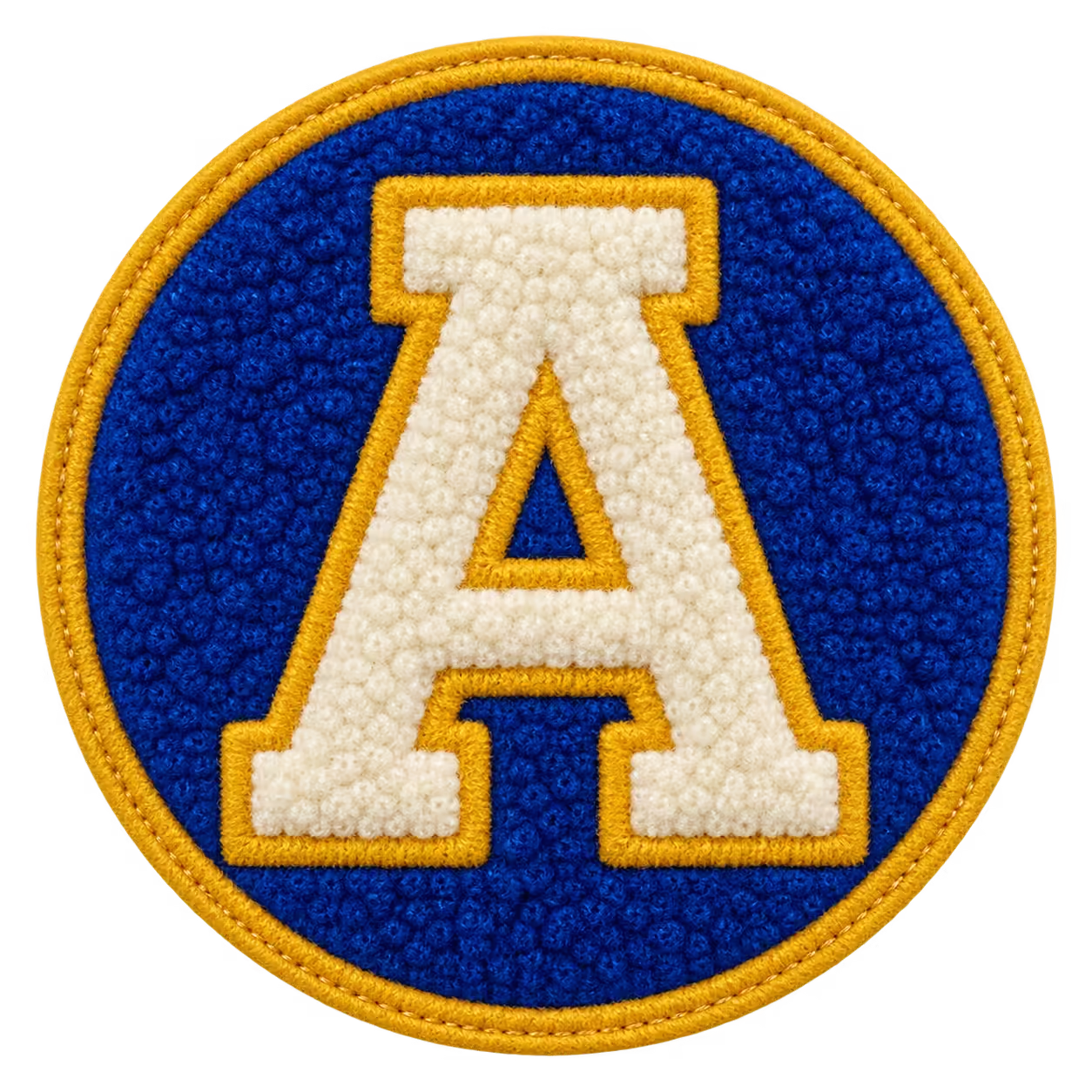
Chenille patches use textured yarn to create a soft, raised appearance. Large letters and simple shapes let that texture become a visible part of the design rather than a detail that disappears at a distance.
A patch worth wearing.
For a jacket emblem, wordmark or clothing project, begin with the shape and scale. The smallest features may need a different treatment from the large textured areas.
Ordering and delivery
Chenille patch orders start at 10 pieces per design. Digitising and a digital proof are included free of charge, with no separate setup fee. We quote the quantity, size, technique and backing; higher quantities reduce the unit price.
Review the proof and request any changes before approval. Production starts only after approval, and the finished order is inspected before dispatch. Approximate total turnaround is 10–14 days including production and delivery throughout the Netherlands and EU.
Which designs suit a chenille finish?
Letters and numbers
A clear silhouette helps a letter remain recognisable when texture fills its surface. Review the internal spaces, joins and distance between characters. A small opening that looks adequate in flat artwork may not provide the visual separation you want in the finished patch.
Bold logos and simple shapes
Look for the elements that define the logo from a distance. A strong outline gives the textured area a clear shape. Fine outlines, tiny text or intricate illustrations may need simplification or another construction.
Mixed textures
If a design combines large textured areas with smaller details, ask whether the offered process supports a combined construction. Do not assume that every chenille design can include every embroidery or print treatment.
Choose the base, colours and outline
The visible base and edge can contribute to the design as much as the yarn. Specify whether you want a contrasting outline, a subdued background or a closely trimmed shape, then confirm which options are available.
Supply colour references when matching a brand or garment. Assess samples as physical materials where the difference between shades matters; a screen image cannot fully communicate texture or colour under different light.
Size the patch for the finished garment
Measure the placement before choosing dimensions. Consider how the patch sits across seams, curves and areas that fold when the garment is worn. A paper template helps check proportion before production decisions are made.
Use the patch size guide to record width, height and orientation. If several patches will be arranged together, show their spacing on the garment rather than supplying only separate files.
Confirm attachment and care
The patch's face material does not determine which backing will work with your garment. Provide the garment composition and intended care process, then agree a suitable attachment for the complete construction.
Before ordering for a clothing range, consider a sample on the actual garment. Placement, flexibility and cleaning behaviour are easier to assess on the finished item than on a loose patch.
Chenille patch questions
Can a detailed crest be made in chenille?
It needs an artwork assessment. The main shapes may suit chenille while small details require a revised layout or another technique. Identify which elements must be preserved.
Can chenille be combined with another finish?
Ask which combinations the production process supports. A reference image describes the result you want, but the quotation should identify the actual construction.
What affects the quote?
Dimensions, design, construction, quantity and attachment all help define the order. Include the delivery location and deadline so the commercial requirements can be assessed together.
Compare other patch types or send your chenille design enquiry.
Let’s make it yours.
Your design, checked with you before production.